

Abstract
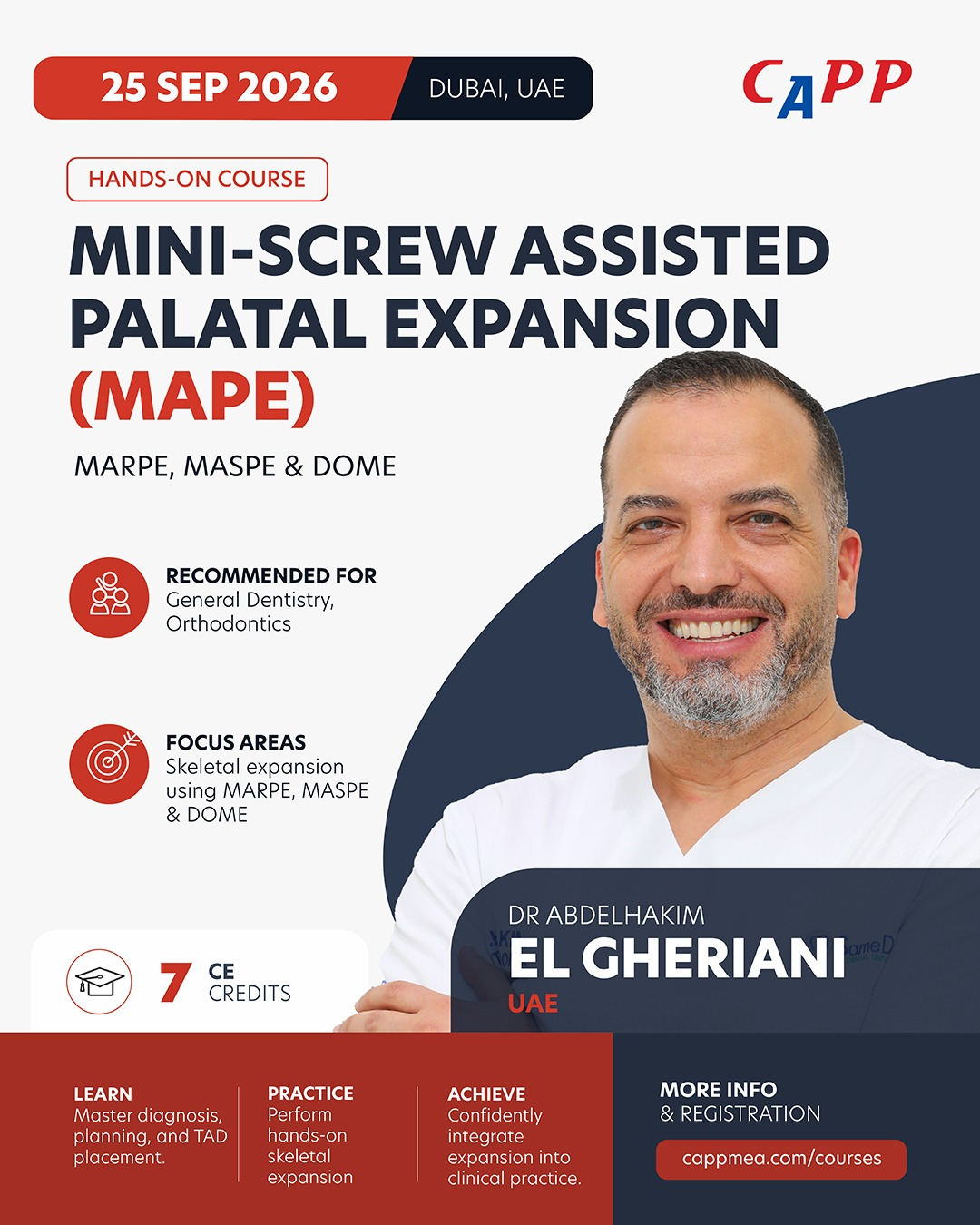
This focused one-day hands-on workshop is designed for orthodontists and dental professionals seeking a practical and evidence-based introduction to contemporary skeletal expansion techniques.
This intensive program will explore the biological principles, diagnosis, case selection, treatment planning, appliance design, clinical protocols, and management of complications related to Mini-screw Assisted Rapid Palatal Expansion (MARPE), Mini-screw Assisted Slow Palatal Expansion (MASPE), and Distraction Osteogenesis Maxillary Expansion (DOME). Participants will gain a clear understanding of the differences, indications, and limitations of each approach, with emphasis on integrating these modalities into modern interdisciplinary practice.
Through lectures, case discussions, and guided practical exercises, attendees will develop confidence in selecting appropriate cases, planning expansion strategies, and understanding the biomechanics and clinical workflow involved in mini screw–assisted expansion. The hands-on component will provide direct experience with appliance components, placement concepts, and protocol-based decision-making, bridging theory with clinical application.
By the end of the workshop, participants will be equipped with the foundational knowledge and practical insight needed to apply M.A.P.E. concepts safely and effectively in everyday practice.
Objectives
- Differentiate between various expansion modalities, specifically contrasting the clinical indications, biomechanics, and expected outcomes of MARPE, MASPE, and DOME.
- Identify ideal candidates for skeletal expansion by analyzing diagnostic data, including CBCT imaging, to assess mid-palatal suture maturation and cortical bone thickness.
- Master the biomechanical principles of mini-screw placement, focusing on the selection of appropriate insertion sites, screw dimensions, and the importance of bicortical engagement for maximum stability.
- Design and customize expansion appliances based on individual patient anatomy and specific treatment goals, including the choice between tooth-borne, bone-borne, and hybrid designs.
- Implement standardized clinical protocols for the activation, maintenance, and retention phases of skeletal expansion to ensure predictable orthopedic results.
- Recognize and manage potential complications, such as mini-screw failure, soft tissue impingement, asymmetric expansion, and periodontal considerations.
- Apply hands-on technical skills through practical exercises involving the assembly, positioning, and stabilization of M.A.P.E. components.
- Integrate skeletal expansion into interdisciplinary workflows, understanding how these techniques facilitate better outcomes in airway management, orthognathic surgery, and complex orthodontic cases.
Learning Objectives
- By the end of the workshop, participants will be able to:
- Evaluate patients for MARPE, MASPE and DOME using clinical examination and CBCT records.
- Identify optimal TAD insertion sites and assess bone availability.
- Design skeletal expansion appliances based on individual patient requirements.
- Create and utilize surgical guides for accurate mini-screw placement.
- Perform appliance-first placement workflows with confidence.
- Perform bone-first placement workflows and understand their clinical indications.
- Recognize and manage common complications associated with mini-screw assisted expansion.
- Integrate skeletal expansion techniques into contemporary orthodontic and interdisciplinary treatment protocols.
Agenda
| 09:00 – 09:15 | Introduction: Welcome & Course Overview |
| 09:15 – 10:00 | Fundamentals of Skeletal Expansion: Biology of the Midpalatal Suture, Growth Considerations, and Biomechanics |
| 10:00 – 10:45 | Understanding MARPE, MASPE & DOME: Indications, Case Selection, Diagnostic Records and CBCT Assessment |
| 10:45 – 11:00 | Coffee Break |
| 11:00 – 11:45 | Mini-Screw Fundamentals: TAD Selection, Stability, Anatomical Considerations and Risk Management |
| 11:45 – 12:25 | Hands-On Exercise 1: Appliance-First Placement Protocol – Clinical Workflow and Practical Application |
| 12:25 – 12:30 | Review – Q&A |
| 12:30 – 13:15 | Lunch |
| 13:15 – 14:00 | Appliance Design Principles: Tooth-Borne, Bone-Borne and Hybrid Expansion Systems |
| 14:00 – 14:45 | Hands-On Exercise 2: Screw Site Selection Using Clinical Cases and CBCT Analysis |
| 14:45 – 15:30 | Hands-On Exercise 3: Appliance Design Workshop – Selecting and Designing Appropriate Expanders |
| 15:30 – 15:45 | Coffee Break |
| 15:45 – 16:45 | Hands-On Exercise 4: Surgical Guide Design for Accurate TAD Placement |
| 16:45 – 17:30 | Hands-On Exercise 5: Bone-First Appliance Placement Protocol – Guided Placement and Verification |
| 17:30 – 17:50 | Troubleshooting & Complication Management: Failure Analysis, Expansion Monitoring and Retention Strategies |
| 17:50 – 18:00 | Open Discussion, Questions and answers |